
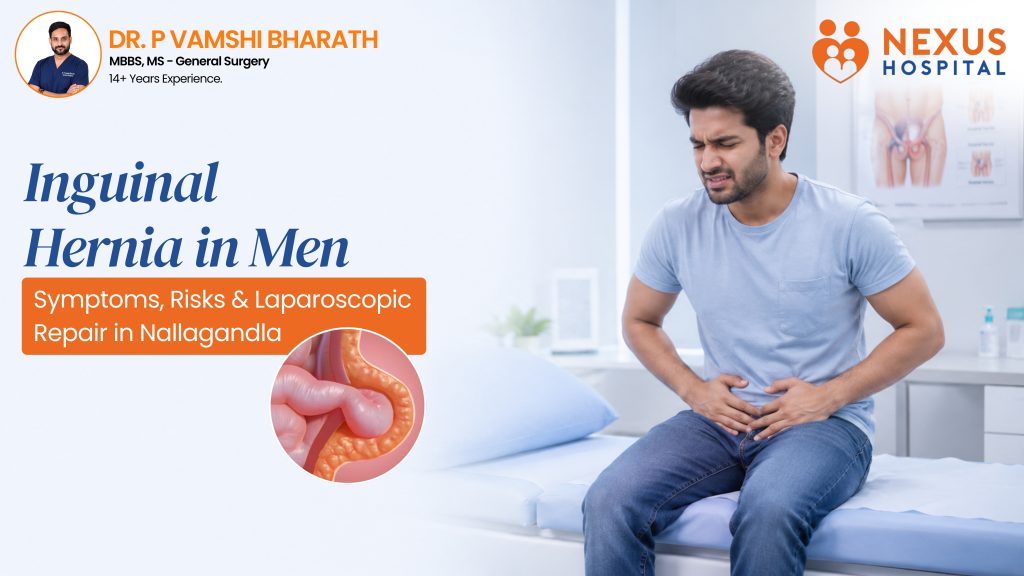
A Small Bulge Today Can Become a Bigger Problem Tomorrow
Many men ignore a small swelling in the groin because it doesn’t hurt much or disappears when they lie down. It may seem harmless at first, but this could be an inguinal hernia—a condition that does not heal on its own and often worsens over time.
Simple daily activities like lifting heavy objects, coughing, exercising, or even standing for long periods can make the hernia larger and more uncomfortable. Left untreated, it may lead to serious complications that require emergency surgery.
If you’re considering laparoscopic inguinal hernia repair in Nallagandla, understanding the symptoms, risks, and available treatment options can help you make an informed decision before complications develop.
What Is an Inguinal Hernia?
An inguinal hernia occurs when a portion of the intestine or fatty tissue pushes through a weak area in the lower abdominal wall near the groin. It is the most common type of hernia and occurs far more frequently in men than in women due to natural differences in abdominal anatomy.
Some hernias remain small for months, while others gradually increase in size, causing pain and limiting normal daily activities.
Since the weakness in the abdominal wall does not repair itself naturally, surgery is the only permanent treatment.
Common Symptoms of an Inguinal Hernia
The symptoms often develop gradually and may become more noticeable during physical activity.
Common signs include:
- A visible bulge in the groin area
- Swelling that becomes more noticeable while standing
- Groin pain or discomfort during lifting or bending
- A feeling of heaviness or pressure in the lower abdomen
- Burning or aching sensation around the bulge
- Pain after prolonged walking or exercise
- Swelling extending into the scrotum in some men
In the early stages, the bulge may disappear when lying down, but this does not mean the hernia has healed.
Why Are Men More Likely to Develop Inguinal Hernias?
Men naturally have a weaker area in the groin where blood vessels and the spermatic cord pass through the abdominal wall. This makes them more susceptible to developing inguinal hernias.
Several factors can increase the risk, including:
- Heavy lifting
- Chronic coughing
- Obesity
- Smoking
- Aging
- Family history of hernias
- Previous abdominal surgery
- Chronic constipation causing repeated straining
Even healthy individuals can develop an inguinal hernia if pressure inside the abdomen repeatedly increases over time.
When Should You See a Surgeon?
Many patients postpone treatment because the pain comes and goes. However, hernias usually become larger with time.
Medical evaluation is recommended if you notice:
- A persistent groin bulge
- Increasing pain during physical activity
- Difficulty lifting heavy objects
- Swelling that continues to enlarge
- Pain interfering with work or exercise
Early treatment usually allows for simpler surgery and a quicker recovery.
Can an Inguinal Hernia Become Dangerous?
Yes. Although many hernias begin as mild conditions, delaying treatment increases the risk of complications.
A hernia may become trapped (incarcerated), preventing the intestine from moving back into the abdomen. If the blood supply to the trapped intestine is cut off, it becomes a strangulated hernia, which is a medical emergency requiring immediate surgery.
Warning signs include:
- Sudden severe groin pain
- Redness or discoloration over the swelling
- Nausea and vomiting
- Fever
- Inability to push the bulge back in
- Severe abdominal pain
Prompt medical attention can prevent life-threatening complications.
How Is an Inguinal Hernia Diagnosed?
Diagnosis is usually straightforward and begins with a detailed clinical examination.
Your surgeon may recommend:
- Physical examination
- Medical history review
- Ultrasound scan
- CT scan in selected cases
- Additional investigations before surgery if needed
These tests help determine the size of the hernia and the most suitable surgical approach.
Laparoscopic Hernia Repair: A Modern Treatment Option
The most effective treatment for an inguinal hernia is surgical repair.
Today, many patients are treated using laparoscopic (keyhole) surgery. This minimally invasive technique uses small incisions, a tiny camera, and specialized surgical instruments to repair the weakened abdominal wall. A surgical mesh is generally placed to strengthen the area and reduce the chance of recurrence.
Men seeking treatment for inguinal hernias often benefit from laparoscopic surgery because it offers faster recovery and less postoperative discomfort.
Benefits of laparoscopic hernia repair include:
- Smaller incisions
- Less postoperative pain
- Reduced blood loss
- Lower infection risk
- Minimal scarring
- Faster recovery
- Earlier return to work
- Shorter hospital stay
In certain complex cases, open surgery may be recommended depending on the patient’s condition.
Recovery After Laparoscopic Hernia Surgery
Recovery varies depending on the patient’s overall health and the size of the hernia.
Most patients can expect:
- Most patients are encouraged to start walking within a few hours after surgery.
- Hospital discharge within one day in many cases
- Mild soreness for several days
- Return to office work within one to two weeks
- Gradual return to exercise after medical approval
- Complete recovery over the following weeks
Following postoperative instructions carefully helps ensure proper healing and lowers the risk of recurrence.
Tips for a Smooth Recovery
To support healing after surgery:
- Take prescribed medications as directed
- Keep the incision area clean and dry
- Avoid lifting heavy objects for several weeks
- Eat a fiber-rich diet to prevent constipation
- Stay hydrated
- Walk regularly to improve circulation
- Attend scheduled follow-up visits
- Resume strenuous activities only after receiving clearance from your surgeon.
Good postoperative care plays an important role in long-term surgical success.
Meet Dr. P. Vamshi Bharath
MBBS, MS (General Surgery), FMAS
Fellowship in Minimal Access Surgery
Dr. P. Vamshi Bharath is an experienced general and laparoscopic surgeon specializing in minimally invasive surgical procedures. He has extensive expertise in managing abdominal wall hernias using advanced laparoscopic techniques that promote faster recovery, reduced postoperative discomfort, and improved patient outcomes.
His areas of expertise include:
- Laparoscopic Hernia Repair
- Laparoscopic Appendectomy
- Gallbladder Surgery
- Hemorrhoids (Piles)
- Anal Fissure
- Anal Fistula
- Pilonidal Sinus
- General Surgical Procedures
His patient-centered approach focuses on accurate diagnosis, individualized treatment planning, and comprehensive postoperative care.
Why Choose Nexus Hospital?
Choosing the right hospital is just as important as choosing the right surgeon. Patients seeking treatment at the best multispeciality hospital in Nallagandla benefit from experienced specialists, advanced surgical technology, and comprehensive care under one roof.
At Nexus Hospital, patients receive:
- Experienced laparoscopic surgeons
- Modern operation theaters
- Advanced diagnostic facilities
- Personalized treatment plans
- High standards of safety and hygiene
- Dedicated nursing care
- Efficient emergency services
- Comprehensive postoperative monitoring
The hospital aims to provide quality surgical care while ensuring patient comfort throughout every stage of treatment.
Can an Inguinal Hernia Be Prevented?
Not all hernias can be prevented, especially those caused by inherited weakness in the abdominal wall. However, certain healthy habits may help lower the risk or slow progression.
These include:
- Maintaining a healthy body weight
- Exercising regularly to strengthen core muscles
- Avoiding unnecessary heavy lifting
- Treating chronic cough promptly
- Preventing constipation with a fiber-rich diet
- Using proper lifting techniques
- Quitting smoking
If you notice a groin swelling, early evaluation is the best way to avoid complications.
Frequently Asked Questions
1. Can an inguinal hernia heal without surgery?
No. An inguinal hernia does not heal on its own. Surgery is the only permanent treatment to repair the weakened abdominal wall.
2. Is laparoscopic hernia surgery safe?
Yes. Laparoscopic hernia repair is a well-established and safe procedure performed worldwide. It offers smaller incisions, less pain, and faster recovery for most patients.
3. How long does hernia surgery take?
Most laparoscopic inguinal hernia surgeries are completed within 45 to 90 minutes, depending on the complexity of the case.
4. When can I return to normal activities after surgery?
Most patients resume light daily activities within a few days and return to desk jobs within one to two weeks. Heavy physical work may require additional recovery time.
5. Can an inguinal hernia come back after surgery?
Although recurrence is uncommon with modern laparoscopic mesh repair, following postoperative instructions and avoiding heavy lifting during recovery can further reduce the risk.
Don’t Ignore a Groin Bulge
An inguinal hernia may begin with mild discomfort, but delaying treatment can lead to increasing pain and potentially serious complications. Early diagnosis and timely laparoscopic repair help relieve symptoms, reduce the risk of emergencies, and support a faster return to everyday life.
Book a consultation with Dr P. Vamshi Bharath for expert evaluation and advanced laparoscopic inguinal hernia treatment.
Nexus Hospital
Plot 17/G, HUDA Layout, Nallagandla, Hyderabad – 500019
📞 Phone: 096764 79069